Apartment Feng Shui focuses on improving Qi flow, natural light, air circulation, sound balance, and emotional comfort inside apartments, condos, and urban flats. Because apartments compress energy more than traditional homes, small Feng Shui mistakes can have a bigger impact on sleep, finances, productivity, relationships, and overall wellbeing.
This guide goes far beyond surface tips.
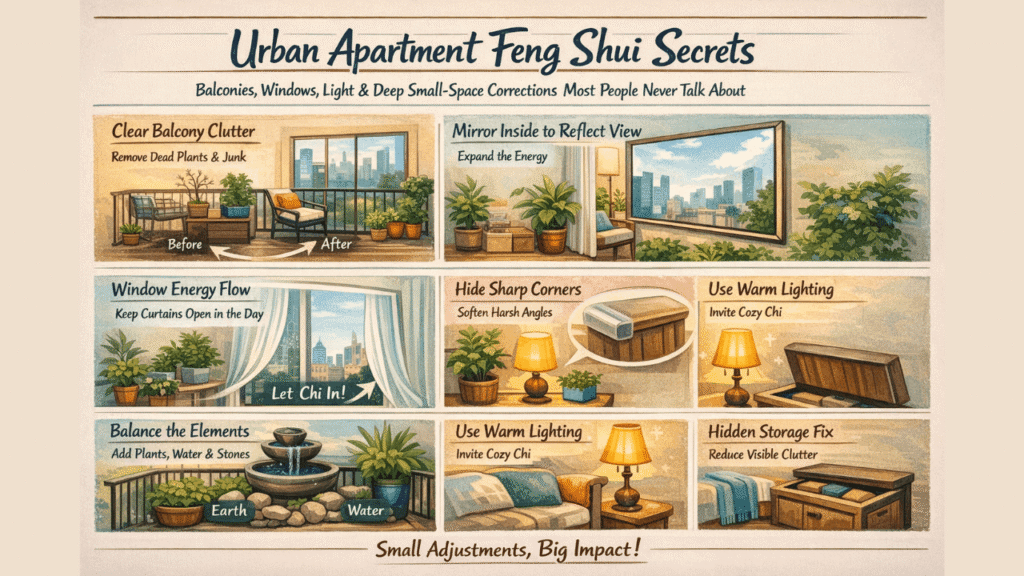
It explains Urban Apartment Feng Shui for Balconies, Windows, Light & Deep Small-Space Corrections Most People Never Talk About.
How energy actually behaves inside modern apartments and how to correct it gently, realistically, and powerfully — without renovations or aggressive cures.
If you live in an apartment and often feel that life is stuck, delayed, or heavier than it should be — even though your home is clean and organized — this is not a coincidence.
Modern apartments hold energy very differently from ground-level houses.
Whether you live in a high-rise condo, a rented flat, or a compact city apartment, these spaces compress Qi.
Light gets recycled. Sound echoes. Movement is restricted. As a result, small Feng Shui mistakes create outsized effects — impacting sleep, finances, focus, emotions, and momentum.
What Is Apartment Feng Shui?
Apartment Feng Shui is the practice of improving energy flow in modern flats, condos, and city apartments where space is limited, walls are shared, and natural light and airflow are reduced.
Unlike traditional homes, apartments require Feng Shui adjustments that focus on circulation, light layering, sound control, and emotional comfort rather than heavy remedies.
Apartment Feng Shui vs House Feng Shui
| Feature | Apartment Feng Shui | House Feng Shui |
|---|---|---|
| Energy Source | Balconies, windows, entry | Land, yard, entry |
| Airflow | Often limited | Usually stronger |
| Natural Light | Frequently reduced | More abundant |
| Noise Levels | Shared walls and traffic | More controlled |
| Qi Movement | Compressed and looping | Broader circulation |
| Main Focus | Light, sound, circulation | Landforms and directions |
Why Urban Apartment Feng Shui Works Differently Than Houses
Traditional Feng Shui developed around land-connected homes — courtyards, gardens, open air, and natural daylight.
Apartments remove almost all of that.
Instead, they experience:
- Vertical stacking of many people’s energy
- Shared walls, floors, and ceilings
- Mechanical airflow instead of natural breeze
- Artificial lighting replacing sunlight
- Constant vibration from traffic, elevators, and electronics
This creates Qi looping, where energy circulates internally instead of moving forward.
When Qi loops too long:
- Motivation drops
- Progress feels slow
- Emotional fatigue builds
- Small problems repeat
Apartment Feng Shui is about breaking loops, not adding decorations.
Signs Your Apartment Has Stagnant Qi
You may have stagnant energy if you regularly experience:
- Feeling tired despite resting
- Lack of motivation
- Repeating financial struggles
- Constant procrastination
- Difficulty focusing while working from home
- Feeling emotionally heavy indoors
- Poor sleep quality
- Frequent minor arguments
At Online Feng Shui Tools, we often notice that these signs become more obvious in small apartments because energy has fewer places to move.
Why Does Feng Shui Feel Stronger in Small Apartments?
Feng Shui feels stronger in apartments because energy has fewer places to move.
When flow is blocked, issues surface faster — emotionally and practically. Small corrections therefore create noticeable results.
Balconies: The Apartment’s Second Mouth of Qi
In many urban apartments, especially in upper floors, the balcony is energetically more important than the front door.
Why?
Because entry doors often open into shared corridors, while balconies open to open sky and distance.
What Apartment Balcony Energy Influences
- Growth and future opportunities
- External support and connections
- Financial inflow in city living
- Mental breathing space
When balcony energy is weak, people often feel boxed in — working hard without visible movement.
Common Balcony Mistakes
Balconies slowly become:
- Storage spaces
- Laundry zones
- Overflow areas
- Forgotten corners
Energetically, this signals: “We are not ready to receive more.”
Advanced Balcony Feng Shui Fixes (Rarely Shared)
The invisible threshold
The first step outside the balcony door must stay open and light. Avoid buckets, heavy planters, or storage here.
Floor energy matters more than décor
Balcony floors anchor stagnant energy. A weekly wash with plain water often lifts emotional heaviness.
One healthy plant is enough
Unhealthy or struggling plants drain Qi in small spaces.
Look up
Dust, cobwebs, or peeling paint above the balcony quietly suppress opportunity — Qi always checks overhead space.
Windows: Where Energy Enters Before Action
In apartments, windows act like decision filters.
Clear windows bring clarity. Blocked windows create hesitation.
What Windows Represent
- Vision and awareness
- Opportunity recognition
- Mental flexibility
- Emotional openness
Subtle Window Issues That Block Energy
Crowded window sills
Leave at least one-third of every sill empty to allow Qi entry.
Windows that never open
Even opening a window briefly resets circulation.
Broken locks or jammed frames
Often reflect fear of change. Fixing them frequently brings mental relief.
Light Feng Shui: Replacing What Nature No Longer Provides
Light is the strongest Feng Shui correction in apartments.
Without proper lighting, other fixes don’t hold.
Why Ceiling Lights Alone Don’t Work
A single overhead light:
- Creates pressure instead of flow
- Flattens the space
- Increases mental tension
Qi needs layers, not floods.
Correct Lighting for Apartments
Every room benefits from:
- One overhead light
- One side or corner lamp
- One low, warm lamp
Even dim lights matter.
Overlooked Lighting Problems
- Dark corners cause subconscious avoidance
- Harsh white light increases anxiety
- Uneven lighting creates emotional imbalance
Warm, layered light calms the nervous system.

Small Apartment Feng Shui: Micro Details That Matter
In compact homes, inches matter.
Space Behind Doors (Hidden Dead Zones)
Energy stagnates easily behind doors.
Activate with:
- A hook
- Hanging item
- Soft light
Never leave it dark and empty.
Furniture Breathing Room
Furniture pressed tightly against walls traps flow. Even a small gap restores circulation.
Sharp Corners
Unsoftened corners compress Qi also called (Poison arrows). Soften with plants, fabric, or rounded décor to reduce emotional sharpness.
Ceilings & Height: Invisible Pressure Points
Low ceilings amplify stress.
Helpful corrections:
- Light ceiling colours
- Vertical curtains or patterns
- Avoid heavy décor overhead
Ceiling fans directly above beds often disturb rest energy.
Sound & Vibration: The Most Ignored Apartment Issue
In city apartments, sound is energy.
Traffic noise, neighbours, elevators — all affect emotional balance.
Helpful fixes:
- Rugs absorb vibration
- Fabric headboards ground sleep
- Soft curtains reduce sharp sound
Wind chimes should be small and subtle — used for regulation, not display.
Hidden Feng Shui Drains in Apartments
These quietly stall progress:
- Shoes piled near entrances
- Items stored under beds
- Broken switches
- Mirrors reflecting clutter
- Excess visible wires
Fix one area at a time.
Does Feng Shui Work in Rented Apartments?
Yes, Feng Shui works extremely well in rented apartments.
The most effective changes involve:
- Cleanliness
- Lighting
- Air circulation
- Symbolic placement
- Intention
No renovation is required.
Daily Apartment Energy Reset (Simple & Powerful)
Once a day:
- Open a window
- Turn on one warm lamp
- Clear one surface
- Water a plant
- Pause near the balcony and breathe
This breaks energy loops gently.
Why Apartment Feng Shui Often Fails
Apartment Feng Shui fails when people:
- Overdo cures
- Ignore basics
- Expect instant changes
- Treat Feng Shui as decoration
Consistency matters more than perfection.
How All These Fixes Work Together
- Balconies invite opportunity.
- Windows guide movement.
- Light sustains flow.
- Small corrections prevent stagnation.
Nothing works alone — everything reinforces everything else.
Final Takeaway
Apartment Feng Shui is not about controlling energy.
It’s about supporting the body and mind gently.
- Walk through your space slowly.
- Notice what feels heavy.
- Notice what light doesn’t reach.
- Notice what feels forgotten.
Feng Shui responds to awareness, not force.
- May your apartment feel lighter.
- May your space support your growth.
- And may small corrections create meaningful shifts.
Recomended Feng Shui Resources
- Feng Shui Remedies for Homes With No Entry Foyer
- 9 Feng Shui Tools For American Homes
- How to Feng Shui a Small Home Office in Apartments
Best Feng Shui Features For Apartments
| Feature | Benefit |
| Healthy plants | Fresh growth energy |
| Warm layered lighting | Balanced Qi flow |
| Clean windows | Mental clarity |
| Organized entryway | Better opportunities |
| Open balcony space | Future growth |
| Natural materials | Grounding energy |
| Soft fabrics | Emotional comfort |
| Decluttered surfaces | Improved focus |
Common Apartment Feng Shui Problems
| Problem | Feng Shui Impact |
| Dark rooms | Low vitality |
| Cluttered balcony | Blocked opportunities |
| Closed windows | Stagnant Qi |
| Excess electronics | Mental fatigue |
| Visible wires | Chaotic energy |
| Poor lighting | Emotional heaviness |
| Shared wall noise | Restlessness |
| Overcrowded furniture | Restricted movement |
Feng Shui For Studio Apartments
Studio apartments require special attention because every life activity happens within one open space.
Studio Apartment Feng Shui Tips
- Separate sleeping and working zones visually.
- Avoid seeing your bed while working.
- Use rugs to define different energy areas.
- Keep the center of the room open.
- Use mirrors carefully to avoid overstimulation.
Even small boundaries help create healthier Qi movement.
Apartment Feng Shui Checklist
Before buying expensive cures, check these basics first.
| Feng Shui Check | Status |
| Balcony clear of clutter | Yes/No |
| Windows cleaned regularly | Yes/No |
| Natural light maximized | Yes/No |
| Warm lighting added | Yes/No |
| Entryway organized | Yes/No |
| Healthy plants maintained | Yes/No |
| Visible wires reduced | Yes/No |
| Furniture not overcrowding space | Yes/No |
| Bedroom feels calm | Yes/No |
| Daily airflow refreshed | Yes/No |
Feng Shui Mistakes Apartment Residents Make
Using Too Many Feng Shui Cures
Many people overload their apartments with crystals, mirrors, symbols, and decorations.
Good Feng Shui is about flow, not quantity.
Ignoring The Balcony
In modern apartments, balconies often act as major Qi entry points.
Keeping Dead Plants
Dead plants represent declining energy and should be removed promptly.
Relying Only On Ceiling Lights
Layered lighting is usually more effective.
Storing Excess Items Under Beds
This can create stagnant energy that affects sleep and emotional wellbeing.
Our Experience With Apartment Feng Shui
At Online Feng Shui Tools, we have noticed that apartment dwellers often focus on decorations while overlooking the factors that matter most.
In our experience, the biggest improvements usually come from:
- Better lighting
- Cleaner windows
- Improved airflow
- Organized entryways
- Balcony activation
- Reducing clutter
These simple changes frequently create more noticeable shifts than expensive Feng Shui cures.
Frequently Asked Questions About Apartment Feng Shui
Can Feng Shui really help in small apartments?
Yes. Small apartments respond quickly to Feng Shui because energy circulates faster. Even minor changes can create noticeable emotional and practical shifts.
Why do apartments feel energetically heavy?
Apartments trap energy due to limited airflow, artificial lighting, shared walls, and constant vibration, causing Qi to loop internally.
Is balcony Feng Shui more important than the front door in apartments?
In many high-rise apartments, yes. Balconies connect to open space instead of shared corridors, making them key energy gateways.
How often should windows be opened for good Feng Shui?
Daily, even briefly. Opening windows resets stagnant energy and improves clarity.
What lighting is best for apartment Feng Shui?
Layered lighting using warm tones works best. Avoid relying on a single overhead light.
Is Feng Shui different for flats and condos compared to houses?
Yes. Flats and condos require corrections focused on circulation, sound, light, and emotional grounding rather than traditional land-based Feng Shui methods.