L-shaped living rooms are a common feature in modern homes, especially in open-plan layouts, apartments, and renovated spaces. While they look stylish and flexible, they often create one major challenge—figuring out the right sofa placement.
With multiple windows, limited solid walls, and two connected areas instead of one clear space, it’s easy to end up with a layout that feels unbalanced or uncomfortable.
In Feng Shui, the sofa plays a central role in how energy flows through your living room. The way it is positioned can affect not just the look of your space, but also how supported, relaxed, and connected the room feels.
In this guide, you’ll learn the best L Shaped Living Room Sofa Placement, including where to position a couch, sectional, or L-shaped sofa for better balance, support, and comfortable energy flow.
Quick Answer
The best sofa placement in an L-shaped living room is along the longest solid wall, facing the entrance (but not directly aligned), with a strong backing for support. Avoid splitting the L shape, blocking pathways, or placing the sofa with its back to the door. Use rugs and furniture to balance both arms of the L and maintain smooth energy flow.
This becomes even more important in modern layouts like open floor plan homes, where furniture placement directly controls how energy flows across connected spaces.
Feng Shui Sofa Placement: The Most Important Rule
The most important rule for Feng Shui sofa placement is to give the main seating a sense of support while maintaining a comfortable view of the room entrance.
Ideally, place the sofa against a solid wall and position it so you can see the doorway without sitting directly in line with it. This is commonly known as the command position.
Good couch placement Feng Shui should also keep natural walking paths open. Avoid positioning a large sofa where people constantly have to walk around it or squeeze between the couch and other furniture.
For an L-shaped living room, the longest solid wall is often the best starting point, but the final Feng Shui sofa position should also consider doors, windows, pathways, and the room’s main activity area.
Why L-Shaped Living Rooms Feel So Tricky
The challenge with L-shaped living rooms isn’t just their shape—it’s how the space is divided into two separate but connected zones.
Unlike rectangular rooms, where furniture naturally aligns with the walls, an L-shaped layout creates competing areas. One side often becomes the main focus, while the other feels underused or disconnected.
This leads to common layout problems such as:
- Uneven balance, where one side feels crowded and the other feels empty
- Multiple focal points, like a TV, window, or entrance competing for attention
- Interrupted flow, especially in open-plan homes where pathways cross the space
- Limited placement options, due to windows, doors, or open walkways
Because of this, many homeowners struggle with:
- Where should the sofa go in an L-shaped living room?
- Should it face the window, the TV, or the entrance?
- Why does the room still feel “off” even after decorating?
From a Feng Shui perspective, these issues happen because energy (Qi) does not circulate evenly through the space. The bend in the layout can create missing corners, weak support, and broken flow if the sofa is not positioned correctly.
The key is not to fight the shape—but to work with it by placing the sofa in a way that connects both areas while maintaining balance and support..
Why Sofa Placement Matters in Feng Shui
In Feng Shui, the sofa is not just another furniture piece. It represents:
- support
- comfort
- family connection
- stability
- emotional grounding
- social harmony
In an L-shaped room, the sofa often becomes the main visual and energetic anchor. When it is placed correctly, the room feels calm and welcoming. When it is placed poorly, the room can feel disconnected, awkward, and tiring to sit in.
Poor sofa placement may lead to:
- restless energy
- blocked walking paths
- one dead corner in the room
- poor conversation flow
- a lack of support energy
- constant urge to rearrange furniture
Before moving furniture, it’s important to understand how energy flows in an L-shaped layout.
In Feng Shui, where you sit also influences how opportunities reach you. You can further enhance this by aligning your seating with your wealth directions, calculated using this tool.
Common L Shaped Living Room Layouts in Modern Homes
Not all L-shaped living rooms are the same. The shape may come from different home designs, and each one changes how the sofa should be positioned.
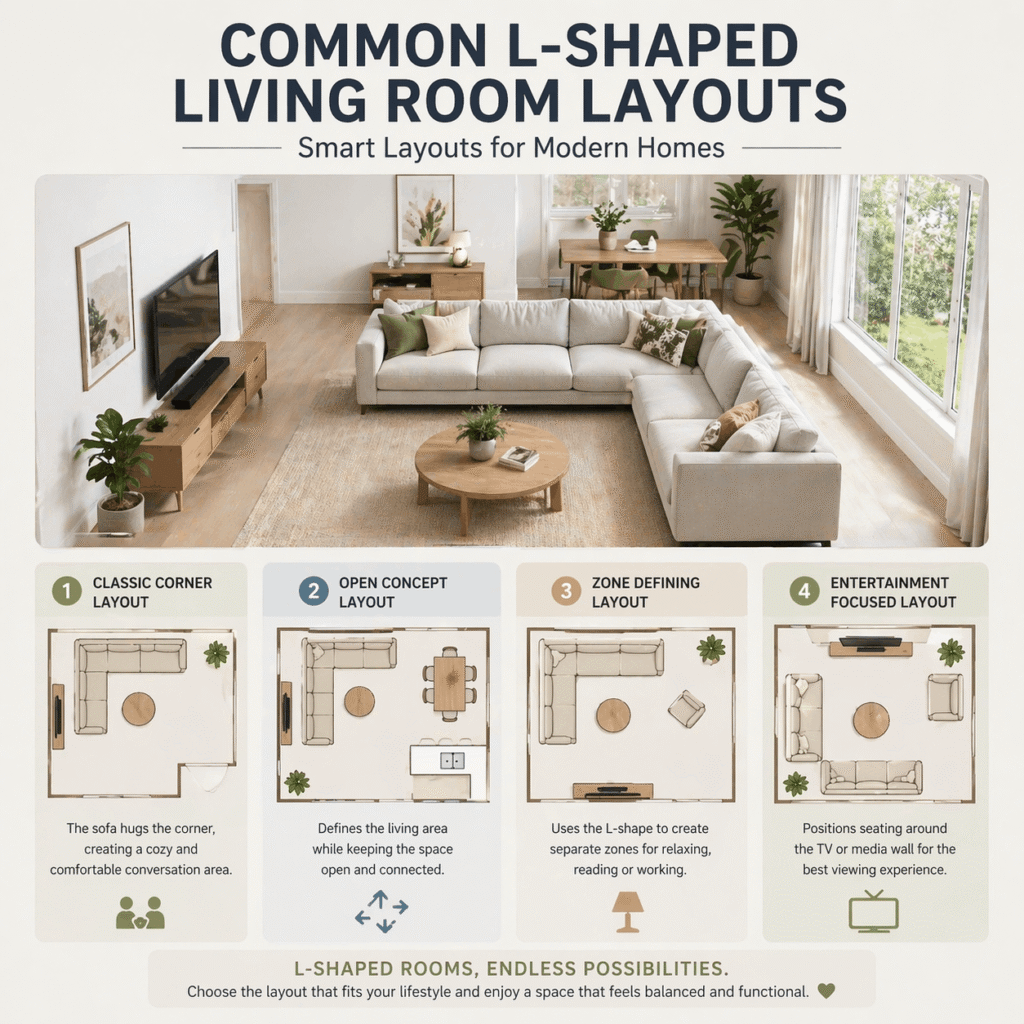
1. Open-Plan Living and Dining Room
One arm of the L acts as the lounge, while the other becomes the dining area.
2. Living Room With Hallway Extension
Part of the L leads to another area of the home such as bedrooms or a passage.
3. Living Room With Bay Window or Rear Extension
This is especially common in UK homes, where an added extension or bay window changes the room shape.
4. Apartment Living Room With Kitchen Arm
The living room flows into the kitchen area, creating an L layout without full walls.
Even though the layout varies, the Feng Shui principles stay the same: the sofa should feel supported, stable, and well-positioned to receive energy.
The Core Feng Shui Rule For L Shaped Living Room Sofa Placement
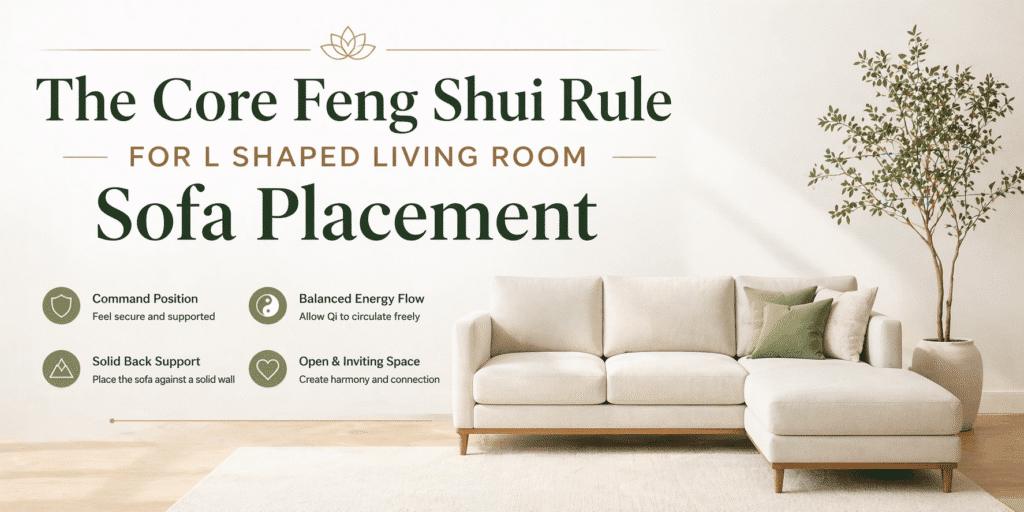
No matter the shape of the room, the sofa should ideally be in the command position.
That means:
- there is a solid wall behind the sofa
- the sofa can see the entrance
- the sofa is not directly in line with the door
- the sofa does not block natural movement through the room
- the seating feels protected and comfortable
This is the strongest starting point for any living room layout.
f you are unsure where your strongest directions are, you can calculate them using the Kua Number Calculator
This helps refine seating orientation for personal comfort and stability.
Best Sofa Placement Rules for an L-Shaped Living Room
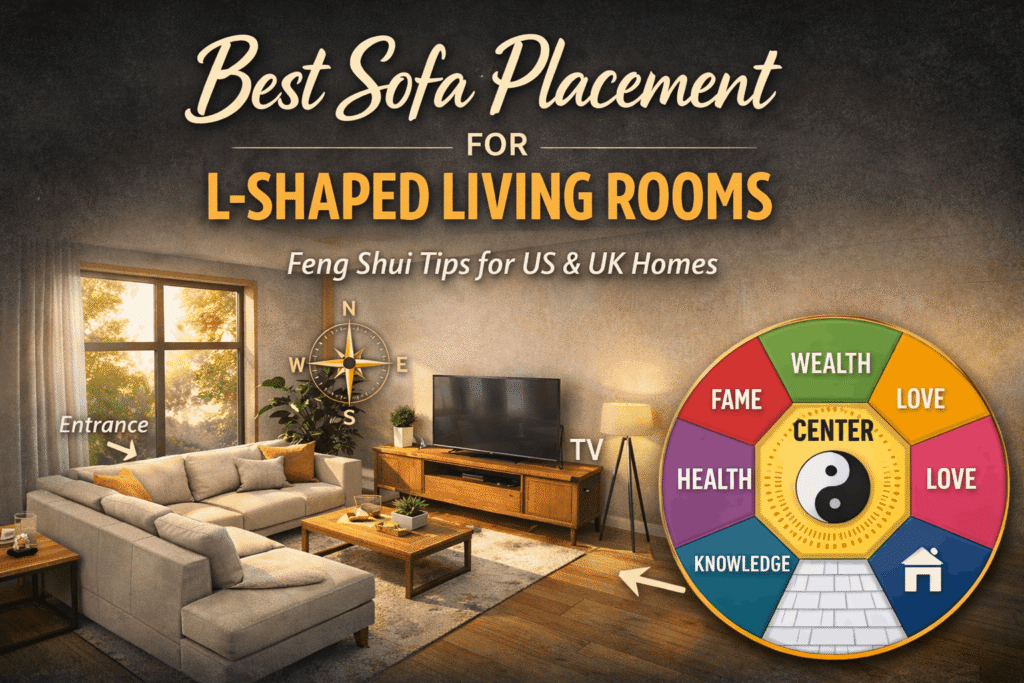
1. Place the Sofa Against the Longest Solid Wall
In most L-shaped living rooms, one wall is longer and more stable than the other. This wall is usually the best location for the main sofa.
According to interior design experts at Elle Decor, the sofa should ideally be placed near a solid wall while maintaining a clear view of the entrance. This setup creates a sense of security and allows energy to flow naturally through the room, which aligns closely with Feng Shui principles of balance and command position.
Why this works
- Long walls provide strong backing
- Energy settles instead of drifting
- Seating feels grounded
- The room feels visually balanced
Avoid placing the main sofa floating in the center of the L unless the space is very large and intentionally zoned.
For guidance on creating strong living room energy, see Living Room Feng Shui Rules for Balance and Comfort
Product ideas:
2. Do Not Split the L Shape in Half
A common mistake is placing the sofa across the bend of the L, which splits the room energetically.
What this causes
- Broken Qi flow
- Visual confusion
- One side of the room feeling unused
- People avoiding certain seating spots
Instead, let the sofa follow the natural shape of the L, not fight it.
If your room feels incomplete or “missing” on one side, read How to Fix Missing Corners in Feng Shui
3. Avoid Sofa Placement With the Back to the Entrance
This is one of the most common Feng Shui mistakes in L-shaped living rooms.
When the sofa has its back to:
- The main door
- A hallway
- A major walking path
People feel subconsciously uneasy.
Feng Shui effects
- Lack of support
- Anxiety or restlessness
- Difficulty relaxing
- Weak authority energy
If your layout forces this placement, add:
- A console table behind the sofa
- A tall plant for energetic support
- A floor lamp to “protect” the back
Since the entrance controls how energy enters your home, it’s important to understand its impact. You can analyze your layout using the Front Door Energy Checker Tool to avoid unintentionally weakening support energy.
Top Picks:
4. Use the Sofa to Define the Living Zone
L-shaped living rooms work best when clearly zoned.
Common zones
- Living / seating zone
- Dining or work zone
- Passage or hallway zone
The sofa should define the living zone, not block energy flow.
To understand where wealth and support zones lie within your living room, use the Bagua Map Calculator
This helps avoid placing heavy seating in sensitive areas.
5. Sectional Sofas Can Work Very Well
Sectional sofas can work beautifully in L-shaped living rooms — if used correctly.
Best practices
- Match the sofa’s L direction with the room’s L
- Keep the longer side against a solid wall
- Avoid blocking windows or doors
- Leave clear walking space behind or beside the sofa
Poorly placed sectionals can trap energy in corners.
- For more guidance, see Common Mistakes In Split Level Homes That Block Energy
How to Arrange an L-Shaped Sofa in a Living Room
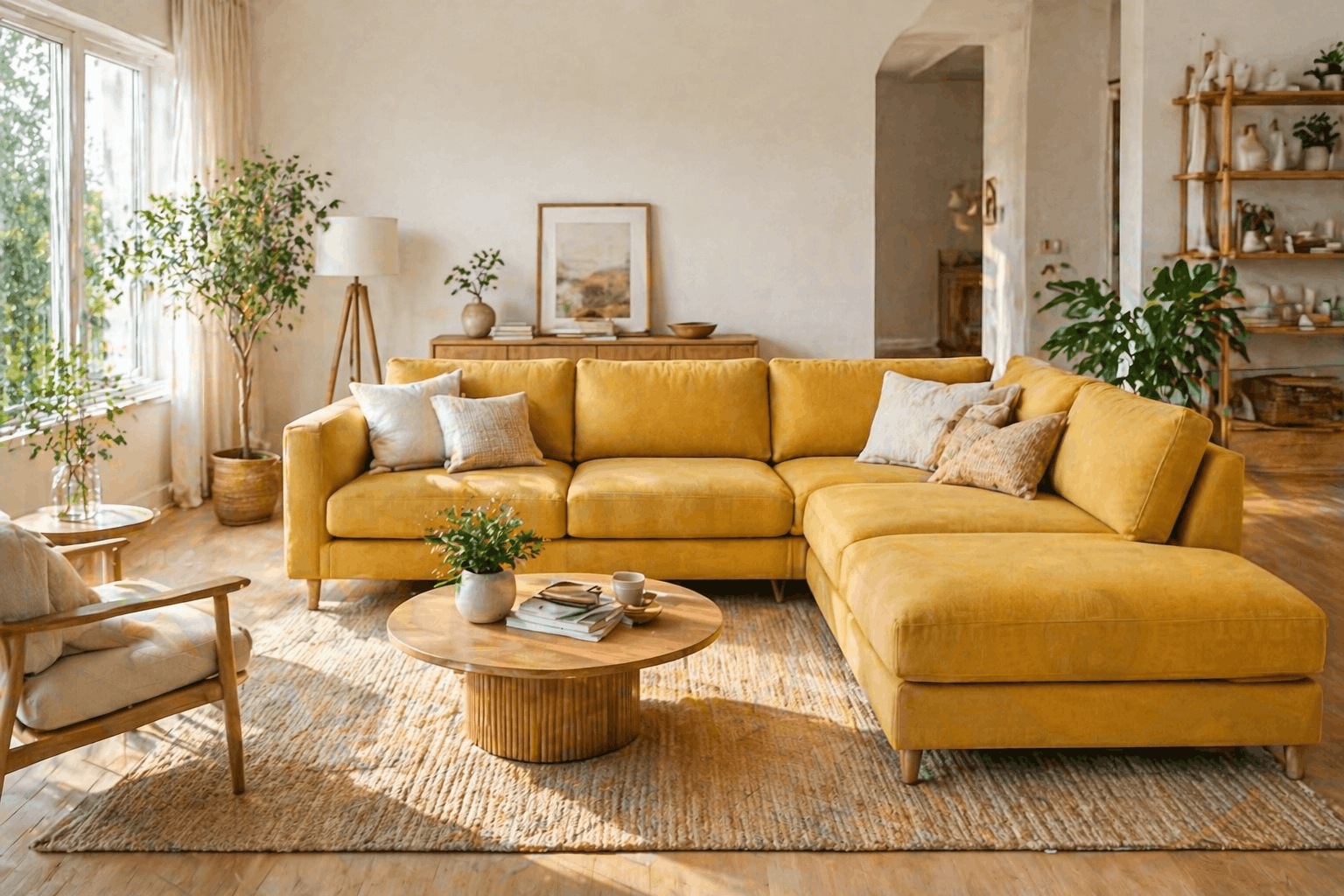
If you’re wondering how to arrange an L-shaped sofa in a living room, start by positioning the longer section along the strongest available wall whenever the layout allows.
The shorter chaise or return section can then help define the seating area without cutting across the room’s main walking path.
For good Feng Shui couch placement:
- Keep the main seating visually connected to the entrance.
- Avoid using the sectional to completely divide the two sides of the room.
- Don’t let the chaise block a doorway or major walkway.
- Leave enough open space around the sofa for comfortable movement.
- Use a rug and coffee table to visually anchor the sectional.
In a small living room, an L-shaped couch can actually save space by providing more seating without requiring several separate chairs.
Is Placing a Sofa at an Angle Good Feng Shui?
Placing a sofa at an angle can work when it improves the room’s natural layout, creates a better view of the entrance, or solves an awkward corner.
However, don’t angle the sofa simply for decoration if it creates unused space behind it or blocks an important walkway.
If an angled couch leaves a large empty corner behind it, use a floor lamp, healthy plant, or small console to make the area feel intentional.
In Feng Shui living room sofa placement, comfort, support, and smooth movement are more important than forcing the sofa to follow a particular angle.
Is Feng Shui Couch Placement Different From Sofa Placement?
No. Feng Shui couch placement and Feng Shui sofa placement follow the same basic principles.
Whether you call it a couch, sofa, loveseat, or sectional, the main seating should ideally have good support behind it, a comfortable view of the entrance, and enough surrounding space for people and energy to move naturally.
The size and shape of the furniture may change the exact layout, but the basic sofa Feng Shui principles remain the same.
6. Use a Rug to Anchor the Sofa Area
Rugs anchor energy.
Without a rug, sofa placement in an L-shaped living room often feels floating or unstable.
Rug Feng Shui tips
- Place front legs of sofa on the rug
- Use one main rug for the seating zone
- Avoid tiny rugs that get “lost”
You can try:
7. Balance the Empty Arm of the L
One arm of the L often feels emptier than the other.
Feng Shui solutions
- Add a chair or loveseat
- Use a floor lamp
- Place a tall plant
- Add artwork to visually complete the space
Avoid leaving one arm completely empty, as it creates energy imbalance.
8. Sofa Facing Windows: Is It Good or Bad?
In US and UK homes, large windows are common.
Facing windows is acceptable if:
- The sofa has a solid wall behind it
- The window is not floor-to-ceiling
- Curtains or blinds soften the energy
Avoid placing sofas directly against large glass panels without support.
9. Keep the TV Secondary, Not Dominant
In many homes, sofa placement revolves around the TV.
Feng Shui tips
- TV should not dominate the room
- Sofa should not be too close
- Avoid placing TV in a commanding position over people
For deeper insight, see TV Placement Feng Shui Rules for Living Rooms
10. Choose Sofa Colours and Materials Carefully
The sofa’s material and colour affect energy flow.
Best choices
- Fabric or leather with soft finish
- Earthy or neutral tones
- Avoid sharp, shiny materials
Colours should complement the overall room balance.
Avoid very harsh, shiny, or sharp-looking finishes if you want the room to feel softer and calmer.
Best Sofa Placement by Layout Type
| Layout Type | Best Sofa Placement | What to Avoid |
|---|---|---|
| Open-plan living + dining | Against the longest wall in the living zone | Floating in the middle without support |
| Hallway extension L-shape | On a solid wall away from the active walkway | Back to hallway traffic |
| Bay window UK layout | Against the strongest internal wall | Blocking the bay or forcing awkward angles |
| Apartment kitchen arm | Use sofa to clearly define living area | Overcrowding near the kitchen path |
| Large US open-plan room | Anchor with rug and wall support | Leaving the sofa unsupported in open space |
US-Specific Feng Shui Tips for L-Shaped Living Rooms
US homes often have larger open-plan layouts, wider living rooms, and bigger furniture.
That means the main challenge is often too much openness, not too little space.
Best tips for US homes:
- zone the space clearly with rugs
- avoid floating sofas unless they are well supported
- use console tables if the sofa sits away from the wall
- do not let the dining area overpower the living zone
- keep pathways wide and smooth
UK-Specific Feng Shui Tips for L-Shaped Living Rooms
UK homes often have narrower layouts, smaller living rooms, and bay windows.
That means the challenge is often tight space and awkward corners.
Best tips for UK homes:
- use compact sofas instead of oversized sectionals
- avoid heavy furniture near the entrance path
- use the bay window area carefully, without blocking light
- do not overfill both arms of the L
- keep the room visually open
Common Sofa Placement Mistakes in an L-Shaped Living Room
Here are the mistakes that most often weaken Feng Shui in this layout:
Sofa floating without support
This makes the room feel unstable and exposed.
Sofa back facing the entrance
This weakens the sense of security and command.
Blocking pathways
Energy and people should move easily through the room.
Overcrowding one side of the L
This creates imbalance and dead space in the other arm.
Ignoring the rug
Without a grounding piece, the seating area can feel unfinished.
Using oversized furniture
This is especially common in smaller UK layouts where the sofa overwhelms the room.
How to Know If Your Sofa Placement Feels Right
A good Feng Shui setup usually feels right before you even analyze it.
Signs your sofa placement is working:
- you can relax easily
- the room feels welcoming
- pathways are clear
- both arms of the L feel useful
- the room looks balanced from different angles
- seating feels naturally supported
If the room feels awkward, unsettled, or one-sided, the sofa likely needs adjusting.
Feng Shui Tips to Improve an L-Shaped Living Room Fast
Here are simple fixes that can make a big difference:
- move the sofa to the strongest wall
- add a rug under the seating area
- place a plant in the emptier arm of the L
- use lighting to soften dark corners
- add an accent chair to balance the layout
- avoid sharp furniture edges pointing at seating
- keep clutter away from the entrance side of the room
FAQs L-shaped room furniture arrangement
Where should a sofa go in an L-shaped living room?
The sofa should usually go against the longest and strongest wall, where it has support behind it and can see the entrance without sitting directly in line with the door.
Is an L-shaped living room bad Feng Shui?
No, it is not bad by default. But it can easily become unbalanced if the sofa placement creates dead corners, blocked pathways, or poor support.
Can I put a sectional sofa in an L-shaped living room?
Yes, a sectional can work very well if it follows the shape of the room naturally and does not block doors, windows, or movement paths.
Should the sofa face the TV or the entrance?
Ideally, the sofa should be placed so it has awareness of the entrance while still working practically for the room. The TV should not be the only factor deciding the layout.
What if my sofa has to float in the middle of the room?
If the sofa must float, add support behind it with a console table, rug, lamp, or plant so it does not feel exposed and unsupported.
How do I balance the empty side of an L-shaped room?
Use a chair, lamp, plant, side table, or artwork to activate the quieter arm of the room. This helps the whole layout feel complete.
Is it okay to place a sofa near a window?
Yes, as long as the sofa still feels supported and the window energy is softened with curtains, blinds, or balanced furniture placement.
What is the best Feng Shui sofa position?
The best Feng Shui sofa position usually provides a solid wall behind the seating, a view of the room entrance, and clear space around the sofa for comfortable movement. Avoid placing the sofa directly in line with the doorway when another practical position is available.
Can I place my sofa diagonally in the living room?
Yes. A diagonal sofa can work if it improves movement and makes the room feel balanced. Avoid placing the sofa at an angle when it blocks pathways or creates a large, unusable space behind the seating.
Can a couch face the front door in Feng Shui?
It can have a view of the entrance, but it doesn’t need to sit directly opposite or perfectly aligned with the door. The goal is to create a comfortable seating position where occupants are aware of people entering the room.
How should I arrange an L-shaped couch in a small living room?
Place the longest section against a suitable solid wall and keep the shorter section away from important doors and walkways. In small apartment Feng Shui, keeping pathways open is particularly important because oversized furniture can quickly make the room feel crowded.
If you want to take this a step further, you can also use a Feng Shui compass tool to fine-tune your sofa direction and ensure your seating position supports both comfort and long-term stability.
Final Thoughts
L-shaped living rooms are not bad Feng Shui. They simply need more intentional furniture placement than square rooms.
The sofa should never feel random in this layout. It should act like the anchor that holds the room together.
When you place the sofa along a solid wall, allow it to see the entrance, keep pathways open, and balance both arms of the L, the room starts to feel calmer, stronger, and more supportive.
That is the real goal of Feng Shui in a living room: a space that helps you feel grounded, connected, and at ease.