Learn powerful Feng Shui No Foyer Home Cures. Fix open entry layouts, protect energy, and improve wealth flow in USA & Canada homes.
If your front door opens straight into the living room, kitchen, staircase, or hallway, you’re not alone.
In many USA and Canada floor plans—condos, townhomes, split-level homes, open-concept houses, and basement-entry layouts—there’s often no proper entry foyer.
Feng Shui-wise, this matters because the entry is where Qi (energy) enters, settles, and then spreads through your home.
When there’s no foyer, Qi can rush too fast (creating restlessness, money “leaks,” arguments, or constant distractions), or it can feel exposed (no privacy, no grounding, no “landing zone”). The good news: you can create a foyer feeling without renovating.
Below are practical, North America–friendly remedies you can do with simple placement changes, smart storage, and a few carefully chosen items.
What “No Foyer” Really Means in Feng Shui
A missing foyer typically looks like one of these:
1) Door Opens Directly Into Living Room
The sofa, TV, or main seating gets hit with incoming energy immediately.
2) Door Opens Into Kitchen or Dining
Qi mixes with fire (stove) and movement, leading to scattered energy and spending impulses.
3) Door Opens to Staircase
Energy rushes upward too quickly, which can feel like opportunities come but don’t “stay.”
4) Door Opens Into a Long Hallway
Qi speeds like a tunnel, creating fast, unstable energy.
5) Door Opens Into Open-Concept Space
No boundary = no pause = overstimulation, clutter build-up, and weak “home base” energy.
The Main Goal: Create an “Energy Landing Zone”
A foyer is not just a space—it’s a function. Your remedies should create three things:
Slow the Qi
So money, peace, and opportunities “settle” instead of rushing out.
Define a Boundary
So your home feels protected and grounded the moment you enter.
Add a Ritual of Arrival
So the front door becomes a wealth gateway, not a chaotic drop zone.
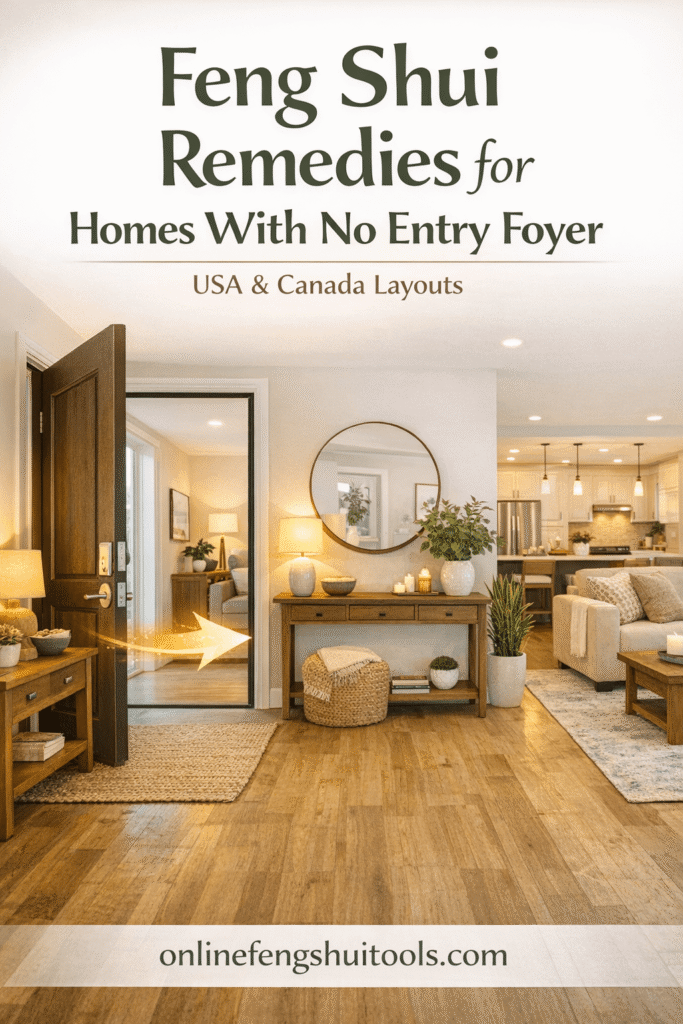
Remedy 1: Mark the Entry With a Rug “Pause Point”
Even if you have only 2–3 feet, a rug tells energy: stop here first.
Best rug styles for USA/Canada layouts
- Runner rug if your door opens into a hall or narrow passage
- Medium rectangle if your door opens into living room
- Easy-clean for Canadian winters (snow/salt)
If you want to combine this with direction-based luck, check your personal favorable directions using the Kua Number Calculator (this helps you align entry routines and key sitting areas): Kua Number Calculator
Best picks (choose one that fits your layout):
- A washable entryway runner rug: Check runner rug options
- A heavy-duty indoor doormat for snow/salt seasons: Check indoor doormat options
Remedy 2: Create a “Foyer Wall” With a Console or Slim Shelf
No foyer? Make one with furniture that creates a visual boundary.
Best choices for small North American entrances
- Narrow console table (8–12 inches deep)
- Floating shelf if space is tight
- Slim shoe cabinet if clutter is the main issue
Place it near the door (not blocking the swing). Add:
- a small lamp (warm light)
- a bowl/tray for keys
- one calming decor item (not too many)
Top picks:
- Slim entryway console table: Check slim console tables
- Key bowl / entry tray: Check entry key trays
Remedy 3: Use Light to “Hold” the Energy
When there is no foyer, lighting becomes your invisible wall.
What works best
- A warm lamp on a console
- A wall sconce near the door
- Soft ceiling light (avoid harsh white light)
Turn it on in the evening even if you’re home—it stabilizes the entry Qi.
If you’re unsure whether your front door energy is “strong,” “leaking,” or unstable, use your tool page as a quick checkpoint: Front Door Energy Checker
Remedy 4: Add a Visual Divider (Without Blocking Movement)
This is a top solution for open-concept homes in the USA and Canada.
Easy divider options
- Tall plant (creates a natural screen)
- Open bookshelf (airy but defining)
- Folding screen (best for renters)
Keep it light and breathable, not like a hard wall.
Recommended picks:
- Folding room divider screen: Check folding divider screens
- Tall indoor plant stand: Check tall plant stands
Remedy 5: Fix the “Door-to-Kitchen” Problem (Very Common in Townhomes)
If your main door opens and you immediately see the kitchen or stove, it can create “burning” energy—too fast, too hungry, too spendy.
Fast remedies
- Add a rug + console to create a pause
- Use a bowl or tray to keep the counter visually calm
- Keep knives and clutter out of sight near the entry line
For bagua-style placement guidance (especially in open layouts), you can use: Bagua Map Calculator
Remedy 6: Staircase Facing the Front Door
This is common in split-level and many newer builds. Energy rushes upward, and it can feel like you’re always “chasing” stability.
What helps most
- Place a rug at the door to slow Qi
- Add a console + lamp to anchor the entry
- Place a tall plant to soften the upward pull
If you want direction-based cures for key areas (like where to sit, work, or place money activators), use: Lucky Direction Calculator
Remedy 7: Mirror Rules for No-Foyer Homes
Mirrors are powerful. Used correctly, they expand space and brighten energy. Used wrongly, they push energy away.
Avoid this
- A mirror directly facing the front door (it can “bounce” Qi back out)
Better options
- Mirror on a side wall near the entry
- Mirror that reflects something beautiful (plant, art, light), not clutter
If your hallway is narrow and you’re trying to “open it up,” do it with side placement + lighting, not a mirror directly opposite the door.
Remedy 8: Control Shoes, Coats, and Winter Mess (Canada Special)
Canadian homes often struggle with heavy coats, wet boots, salt trays, and piles near the door. This creates heavy Qi and can make the whole home feel stuck.
Practical Feng Shui rule
Your entry should feel clear + dry + breathable.
Simple setup that works
- Closed shoe cabinet (or covered bins)
- Hooks for coats (not a mountain on chairs)
- Small tray for wet items (then empty daily)
Remedy 9: Use One “Welcome” Symbol, Not Many
When there’s no foyer, people over-decorate the door area, hoping it “fixes” the energy. In Feng Shui, too much decor becomes clutter.
Keep it clean
Choose one main welcome symbol:
- One art piece
- One plant
- One warm lamp
- One calming scent
That’s it. Let the entry breathe.
Remedy 10: A 5-Minute Entry Reset Routine (Daily Wealth Habit)
This is the fastest way to upgrade a no-foyer home.
Do this every evening
- Put shoes away (or align neatly if you don’t have storage)
- Clear the console (only keys, one tray, one lamp)
- Wipe the mat/rug if needed
- Turn on warm light for 10–20 minutes
- Open the door area for 30 seconds (fresh Qi)
This routine is simple, but it trains your home to receive and keep good energy.
Compass Corrections for USA & Canada Homes
Many homeowners use phone compasses, but interiors (steel doors, wiring, appliances) can distort readings.
For accurate compass/declination info in North America, use NOAA’s geomagnetic tools here.
Once you have better direction accuracy, your Feng Shui tools become even more useful for placements and seating.
Feng Shui No Foyer Home Fixes by Layout Type
Condo / Apartment (Door Opens to Living Room)
- Rug + slim console + lamp
- Side-wall mirror
- One tall plant as soft divider
Townhome (Door Opens to Kitchen or Staircase)
- Rug + console to slow entry
- Keep kitchen line visually calm
- Plant to soften stair pull
Open-Concept House (Big Space, No Boundary)
- Bookshelf divider or screen
- Defined “landing zone” with tray, lamp, art
- Closed storage for shoes/bags
Long Hallway Entry
- Runner + wall lighting
- One artwork midway to slow the tunnel effect
- Avoid clutter against hallway walls
Helpful Resources
- 9 Feng Shui Tools For American Homes
- Best Feng Shui Directions for UK Homes (Compass Corrections)
- 9Feng Shui for US Apartments With Open Floor Plans
- Expert Feng Shui Tips for Canadian Winter Homes
- Best Feng Shui Colors for North-Facing Homes in Western Countries
- How to Feng Shui Wallet for Daily Money Flow
- Best Wealth Plants in Cold Climates (Canada & UK Version)
- Feng Shui Rules for Renting Apartments in the U.S. & Canada
- Feng Shui Bedroom Mistakes Western Homes Commonly Make
- Feng Shui Solutions for Low-Ceiling Bedrooms
Final Thoughts
A missing foyer is not “bad Feng Shui.” It just means you must create a pause, boundary, and arrival ritual so Qi can settle and nourish your home. Start small: rug + light + one landing surface. Then build the system: storage, divider, and daily reset.