
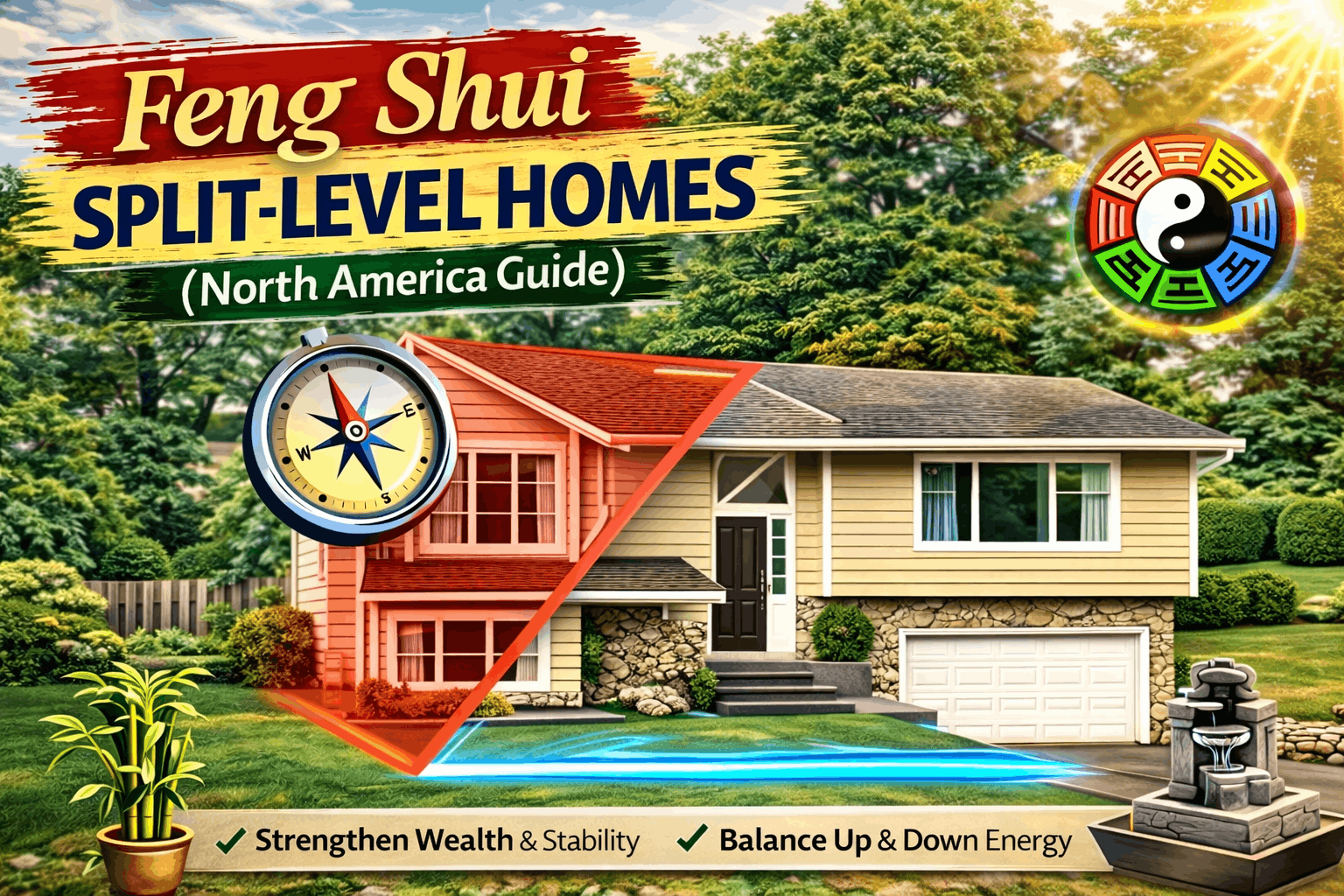
Split-level homes are one of the most common housing styles across the United States and Canada. Built widely from the 1950s through the 1980s, these homes feature staggered floor levels connected by short staircases, with living areas placed half a level above or below each other.
While split-level homes are practical and space-efficient, they often create confusing energy movement when viewed through Feng Shui. Many homeowners living in split-level houses experience similar issues: unstable finances, lack of grounding, family members feeling disconnected, or a constant sense that the home never feels fully settled.
This does not mean split-level homes have bad Feng Shui.
It simply means that energy moves vertically instead of horizontally, and without correction, Qi rushes too fast, skips levels, or pools in the wrong areas.
The good news is that split-level homes respond extremely well to proper Feng Shui adjustments designed for North American architecture.
This guide explains Feng Shui Split Level Homes fixes step by step, using practical remedies that work for USA and Canada layouts, without renovation.
Split-level homes can create unstable Feng Shui because energy (Qi) moves too quickly between levels. The key fixes include anchoring the entry, slowing staircase energy, balancing upper and lower floors, and creating visual and energetic connection across all levels. With the right adjustments, split-level homes can support wealth, stability, and emotional harmony.

What Are Split-Level Homes in Feng Shui?
Split-level homes — very common across the United States and Canada — have staggered floors connected by short staircases.
From a Feng Shui perspective, these homes behave differently because:
- Energy moves vertically (up & down) instead of smoothly flowing
- Qi does not get time to settle and nourish spaces
- Different levels act like separate energy zones
👉 This is why many homeowners feel:
- Financial instability
- Emotional imbalance
- Lack of grounding
- Disconnected family energy
What Makes Split-Level Homes Different in Feng Shui
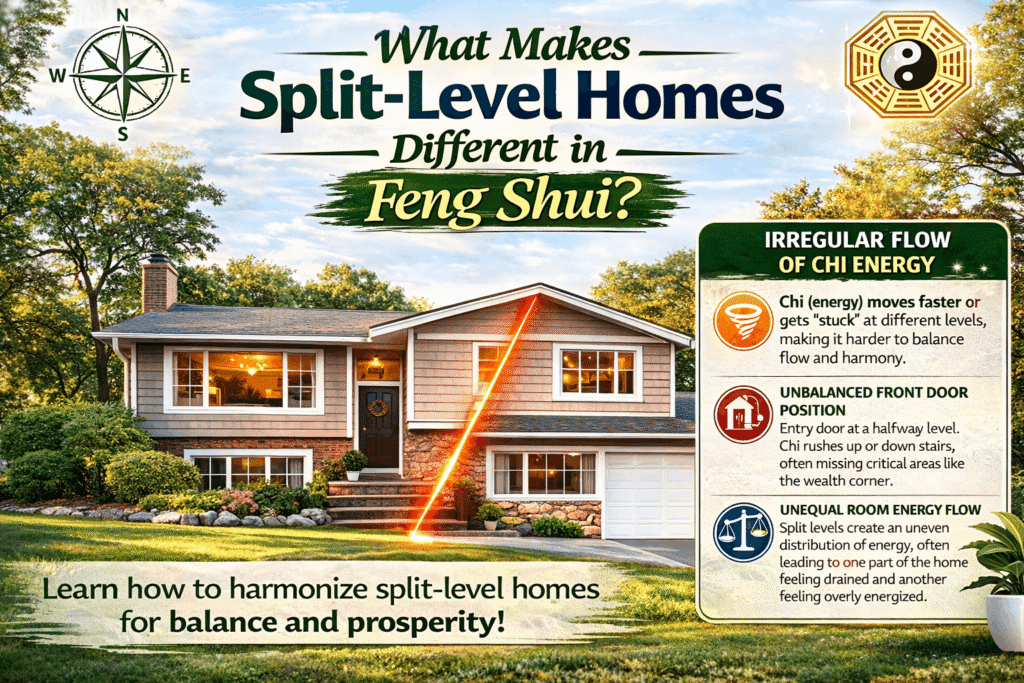
In Feng Shui, homes work best when energy:
- Enters smoothly
- Slows down
- Circulates evenly
- Settles before moving again
Split-level homes interrupt this process.
Typical split-level features include:
- Front door opening to a small landing
- Immediate stairs going up and down
- Living room on a half-upper level
- Bedrooms further up
- Family room, basement, or garage half a level down
From an energy point of view, this creates constant upward and downward pull, which can affect stability, money flow, and emotional balance.
House layout has a big influence on how energy enters, moves, and settles in a home. As explained in this guide on good house floor plan Feng Shui, features like stairs near the entry and split-level layouts can create disrupted energy flow, which is why these homes need extra grounding and balance.
Common Feng Shui Problems in Split-Level Homes
Ideal Feng Shui Energy Flow
A balanced home should allow energy to:
- Enter smoothly
- Slow down naturally
- Circulate evenly
- Settle before moving
What Happens in Split-Level Homes
| Feng Shui Principle | What Goes Wrong in Split-Level Homes |
|---|---|
| Smooth Entry Flow | Interrupted by stairs immediately |
| Energy Retention | Qi escapes upward/downward too fast |
| Balance | Upper & lower levels feel disconnected |
| Stability | Energy never “settles” properly |
👉 Result: A home that feels “off” even if it looks beautiful.
To assess whether your entry energy is strong or leaking, review front-door–related guidance such as Front Door Feng Shui Mistakes That Block Money
The Core Goals For Feng Shui Split Level Homes
Every Feng Shui cure for split-level houses focuses on three main goals:
Anchor the Entry Energy
So Qi does not immediately rush up or down stairs.
Slow Vertical Movement
So energy does not escape to upper or lower levels too quickly.
Reconnect All Levels
So the home functions as one unit, not separate zones.
Step 1: Fix the Entry Level First (Most Important)
In split-level homes, the entry level controls the entire house.
If entry energy is weak, unstable, or cluttered, no other Feng Shui cure will work properly.
Common entry problems in split-level homes
- Small or narrow landing
- Shoes and coats piling up
- Stairs visible immediately
- No pause zone for energy
Feng Shui remedies
- Add a grounding rug (earth element)
- Use warm lighting (not white LED harsh light)
- Keep space minimal & clean
- Add a small console or plant
Entry Fix Impact Table
| Entry Condition | Effect on Life |
|---|---|
| Cluttered entry | Blocked money flow |
| Dark entry | Low energy & motivation |
| Open stairs visible | Wealth leakage |
| Grounded entry | Stability & growth |
To align your entry setup with your personal energy, calculate your favorable directions using the Kua Number Calculator
You can also refer to Entryway Feng Shui Tips for Small Homes
Best product ideas:
Step 2: Control Staircase Energy (Critical in Split-Level Homes)
Staircases act like energy highways.
In split-level homes, stairs are short but extremely active.
If stairs are visible from the front door, energy immediately rushes upward or downward.
Feng Shui problems with stairs
- Qi escapes before nourishing the entry
- Upper floors feel restless
- Lower floors feel heavy or stagnant
Fixes That Work Fast
- Add stair runner rug
- Install wall lights
- Avoid empty/bare stairs
- Keep stairs visually calm
Staircase Energy Fix Table
| Stair Condition | Feng Shui Effect | Fix |
|---|---|---|
| Bare stairs | Fast energy loss | Add runner |
| Dark stairs | Heavy stagnant Qi | Add lighting |
| Direct view from door | Wealth escape | Add visual block (rug/light) |
For deeper understanding, read Staircase Feng Shui Rules You Should Not Ignore
Top product ideas:
Step 3: Balance Upper and Lower Levels
Split-level homes often feel divided.
Upper levels may feel:
- Busy
- Mentally active
- Hard to relax
Lower levels may feel:
- Heavy
- Cold
- Emotionally draining
Your goal is balance, not dominance.
Balance Strategy
| Area | Fix |
|---|---|
| Upper floors | Add soft textures, calm colors |
| Lower floors | Add lighting, warmth |
| Entire home | Maintain visual continuity |
To identify where wealth, support, and stability should be activated, use the Bagua Map Calculator
Step 4: Feng Shui the Living Room in a Split-Level Home
Living rooms in split-level homes are often half a level above the entry.
Best Feng Shui practices
- Use an area rug to anchor seating
- Position sofa with a solid wall behind
- Avoid seating directly facing stair openings
- Keep heavy furniture low and stable
Ideal product ideas:
Step 5: Kitchen Feng Shui in Split-Level Homes
In many split-level houses, the kitchen sits on an upper or mid level and often overlooks other areas.
Common kitchen issues
- Fire energy dominating the home
- Stove visible from stairs
- Visual chaos spreading downward
Fixes
- Avoid cluttered counters
- Keep stove area clean
- Use earth tones (balance fire)
- Add grounding mat
Step 6: Bedrooms on Upper Levels
Bedrooms placed on upper split levels can feel restless.
Improve bedroom Feng Shui by
- Using heavier bedding
- Avoiding mirrors facing stairs
- Keeping lighting soft
- Using solid headboards
Sleeping direction matters greatly in multi-level homes. Use the Lucky Direction Calculator
Step 7: Lower Levels, Family Rooms, and Basements
Lower levels tend to collect stagnant energy.
Feng Shui problems
- Darkness
- Cold temperature
- Storage overload
- Emotional heaviness
Fix Table
| Problem | Solution |
|---|---|
| Darkness | Add warm lighting |
| Clutter | Closed storage |
| Cold feeling | Rugs + warm colors |
| Stagnant energy | Regular cleaning |
Product ideas:
Step 8: Garage Feng Shui in Split-Level Homes
Garages are often connected to lower levels and can drain energy upward.
Feng Shui fixes
- Keep garage door closed
- Avoid using garage as main entrance
- Treat interior garage door like a wall
Fixes
- Keep garage door closed
- Avoid using as main entry
- Treat inside door as boundary
For related guidance, see Feng Shui Cure for Front Door Facing Garage
Step 9: Use Consistent Colors Across Levels
Split-level homes need visual continuity.
Best approach
- Use similar undertones on all levels
- Avoid drastic color changes between floors
- Favor earth tones for grounding
Step 10: Daily Energy Reset for Split-Level Homes
This simple routine keeps Qi balanced.
Every evening
- Turn on lights on each level briefly
- Clear stair landings
- Close doors to unused lower spaces
- Open windows on one level at a time
Common Feng Shui Mistakes in Split-Level Homes
- Ignoring the entry landing
- Letting stairs dominate visually
- Overusing mirrors
- Treating each level as a separate home
- Allowing clutter on stair landings
Best Feng Shui Layout Checklist
| Area | Must Do |
|---|---|
| Entry | Clean + grounded |
| Stairs | Covered + lit |
| Living Room | Anchored furniture |
| Kitchen | Clean + balanced |
| Bedrooms | Stable + calm |
| Basement | Bright + active |
FAQ Section
Is a split-level home bad Feng Shui?
No. It just requires energy control because of vertical movement.
Why do split-level homes feel unstable?
Because Qi moves too quickly between levels without settling.
Can Feng Shui improve finances in split-level homes?
Yes — especially by fixing entry and staircase energy.
What is the most important fix?
Anchoring the entry is the #1 priority.
Final Thoughts
Split-level homes are not bad Feng Shui homes. They simply require intentional energy guidance.
When you:
- Anchor the entry
- Slow staircase energy
- Balance upper and lower levels
- Reconnect zones thoughtfully
Your split-level home becomes stable, supportive, and harmonious.