
Have you ever searched for your Chinese zodiac sign by birth year, only to discover that different websites give you different answers?
Perhaps you were born in January 2000 and always believed you were a Dragon. But according to the traditional Lunar New Year calendar, you may actually belong to the Rabbit zodiac sign.
This happens because the Chinese zodiac year does not begin on January 1.
Your exact birthday matters, especially if you were born in January or February.
In this guide, you will learn how to use a Chinese zodiac birth year calculator, identify your correct animal sign, understand the difference between Chinese New Year and Li Chun, and discover how the five elements relate to your birth year.
Quick Answer: How Do I Find My Chinese Zodiac Sign?
To identify your Chinese zodiac animal correctly, you need your complete date of birth, not just the year.
The familiar Chinese zodiac follows a repeating 12-animal cycle. Under the Lunar New Year convention, your animal year changes on Chinese New Year, which falls between January 21 and February 20.
For example:
- Born January 10, 2024: Rabbit
- Born February 10, 2024: Dragon
- Born January 20, 2025: Dragon
- Born January 29, 2025: Snake
If your birthday falls before Chinese New Year, your zodiac animal belongs to the previous lunar year.
Once you know your sign, explore the Chinese Zodiac Yearly Predictions Tool to discover traditional interpretations for your animal.
You can also use our Five Elements Calculator to explore elemental associations.
If you’re interested in applying traditional calculations to your home, our guide to digital Feng Shui tools for modern homes explains how these resources can help you explore different Feng Shui principles.
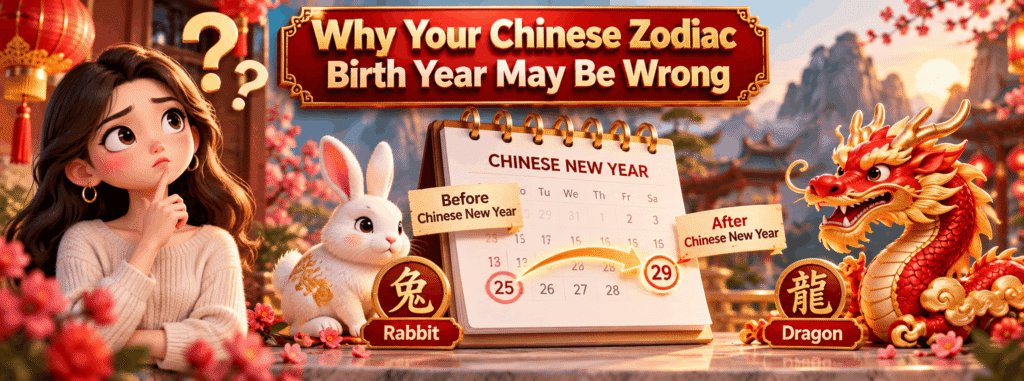
Why Your Chinese Zodiac Birth Year May Be Wrong
Many online charts assign a Chinese zodiac animal based only on the Gregorian birth year.
For example:
- 1999: Rabbit
- 2000: Dragon
- 2001: Snake
- 2002: Horse
These charts are convenient, but they do not always provide the correct answer for people born early in the year.
Chinese New Year follows a lunisolar calendar rather than the Gregorian calendar.
As a result, the zodiac animal associated with a year begins on a different date each year.
Example: January 2000 Birthday
The Year of the Dragon began on February 5, 2000.
Someone born on January 15, 2000, therefore belongs to the Rabbit year under the Lunar New Year convention.
This is why entering your complete date of birth is more accurate than searching only for “Chinese zodiac sign 2000.”
Your birth year is also used in other traditional systems. For example, our Kua Number Calculator explores personal directional associations in Eight Mansions Feng Shui.
However, a Kua number is not the same as a Chinese zodiac animal.
If you are applying Feng Shui while moving into a new property, our guide to Feng Shui for rented homes also explains practical ways to adapt traditional principles without permanent renovations.
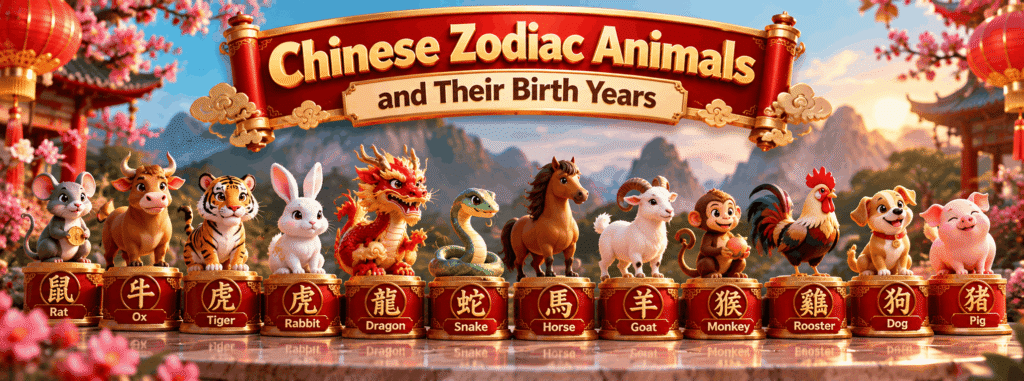
Chinese Zodiac Animals and Their Birth Years
The Chinese zodiac contains 12 animals that repeat in the same order.
| Chinese zodiac animal | Example birth years |
|---|---|
| Rat | 1984, 1996, 2008, 2020 |
| Ox | 1985, 1997, 2009, 2021 |
| Tiger | 1986, 1998, 2010, 2022 |
| Rabbit | 1987, 1999, 2011, 2023 |
| Dragon | 1988, 2000, 2012, 2024 |
| Snake | 1989, 2001, 2013, 2025 |
| Horse | 1990, 2002, 2014, 2026 |
| Goat | 1991, 2003, 2015, 2027 |
| Monkey | 1992, 2004, 2016, 2028 |
| Rooster | 1993, 2005, 2017, 2029 |
| Dog | 1994, 2006, 2018, 2030 |
| Pig | 1995, 2007, 2019, 2031 |
Important: These years are general references. January and February birthdays may belong to the preceding animal year.
The Chinese zodiac is traditionally used to explore personality symbolism, relationships, compatibility, and yearly influences.
If you are interested in how symbolic colors relate to directions and elements, our guide to choosing colors for north-facing homes provides additional examples.
Chinese New Year Dates From 2020 to 2030
A reliable Chinese zodiac calculator by date of birth should use the correct calendar boundary.
The following table shows the beginning of each Lunar New Year.
| Year | Chinese New Year date | Zodiac animal |
|---|---|---|
| 2020 | January 25 | Rat |
| 2021 | February 12 | Ox |
| 2022 | February 1 | Tiger |
| 2023 | January 22 | Rabbit |
| 2024 | February 10 | Dragon |
| 2025 | January 29 | Snake |
| 2026 | February 17 | Horse |
| 2027 | February 6 | Goat |
| 2028 | January 26 | Monkey |
| 2029 | February 13 | Rooster |
| 2030 | February 3 | Dog |
For example, someone born on February 2, 2027, belongs to the Horse year under the Lunar New Year convention.
Someone born on February 10, 2027, belongs to the Goat year.
This distinction is important when researching Chinese astrology, zodiac compatibility, and traditional yearly predictions.
If you are also planning a wedding, move, or business opening, our Auspicious Date Selection Tool explores traditional date-selection concepts. It serves a different purpose from identifying your birth-year animal.
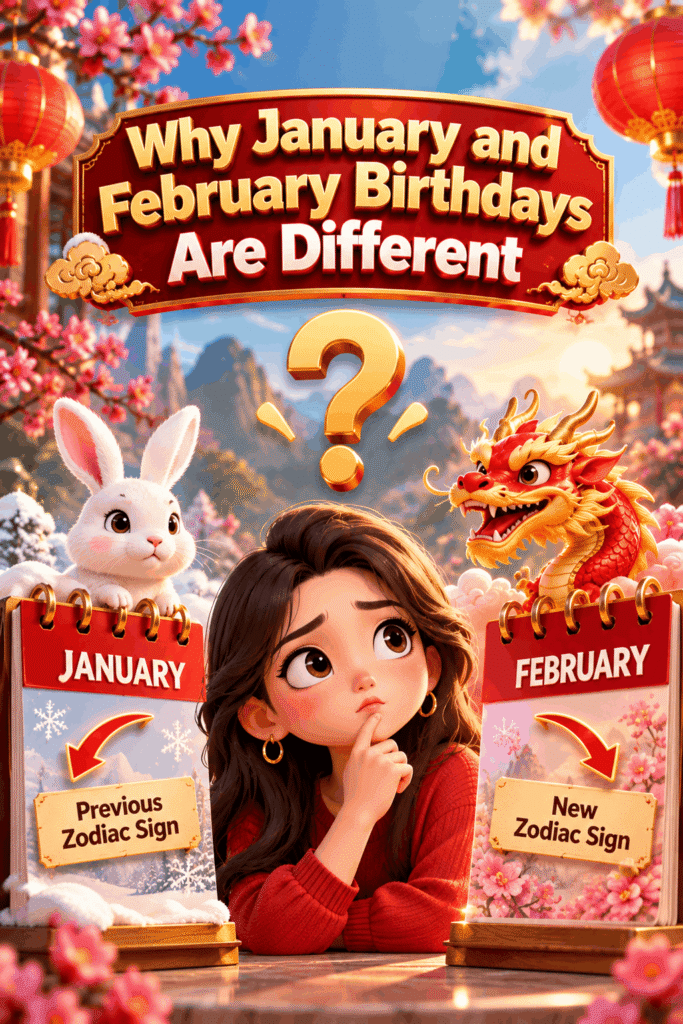
Why January and February Birthdays Are Different
People born in January and February should be especially careful when using simplified zodiac charts.
Chinese Zodiac for January Birthdays
Most January birthdays belong to the zodiac animal associated with the previous Gregorian year.
For example, January 5, 2026, falls in the Snake year because the Horse year begins on February 17.
Similarly, January 10, 2024, falls in the Rabbit year.
However, the exact date still matters.
Someone born on January 30, 2025, belongs to the Snake year because Chinese New Year occurred on January 29.
Chinese Zodiac for February Birthdays
February birthdays require even more attention.
For example:
- February 5, 2024: Rabbit
- February 12, 2024: Dragon
- February 10, 2026: Snake
- February 20, 2026: Horse
This is why a complete birth-date calculation is preferable to a basic year chart.
Once you have identified your zodiac animal, you may also enjoy exploring our Feng Shui ideas for urban apartment living, particularly if you want to connect traditional symbolism with your everyday surroundings.
Chinese Zodiac vs Li Chun: Which Date Should You Use?
One of the most confusing parts of Chinese astrology is that different traditional systems may use different year boundaries.
Two important dates are Lunar New Year and Li Chun.
1. Lunar New Year
Lunar New Year is the familiar boundary used for popular Chinese zodiac animal years.
It is associated with Chinese New Year celebrations and everyday descriptions such as the Year of the Dragon, Snake, or Horse.
For most readers asking “What is my Chinese zodiac sign?”, this is the convention to use.
2. Li Chun, the Start of Spring
Li Chun is one of the 24 traditional Chinese solar terms.
It usually occurs around February 3, 4, or 5.
Some BaZi, or Four Pillars of Destiny, systems use Li Chun to determine the year pillar.
For example, a person born on February 5, 2027, belongs to the Horse year under the Lunar New Year convention because the Goat year begins on February 6.
However, under a Li Chun-based year-pillar convention, the Goat year may already apply.
This does not mean one calculator is automatically wrong. The systems may be using different traditional rules.
The key difference:
- Lunar New Year: commonly used for the familiar Chinese zodiac animal.
- Li Chun: used as the year boundary in many BaZi calculations.
If you are exploring traditional calendar practices beyond your birth sign, our weekly Feng Shui energy cleansing guide offers a separate introduction to symbolic home rituals.
What Is My Chinese Zodiac Element?
Your Chinese zodiac birth year is traditionally associated with both an animal and one of five elements.
These are:
- Wood
- Fire
- Earth
- Metal
- Water
The five elements combine with the 12 animals to form a repeating 60-year cycle.
This means two people can share the same zodiac animal while having different birth-year elements.
For example:
1984 is the Wood Rat year.
1996 is the Fire Rat year.
2008 is the Earth Rat year.
2020 is the Metal Rat year.
Five Elements and Their Traditional Meanings
| Element | Traditional associations | Common colors |
|---|---|---|
| Wood | Growth, creativity, development | Green, brown |
| Fire | Passion, activity, visibility | Red, orange |
| Earth | Stability, patience, grounding | Yellow, beige |
| Metal | Structure, discipline, precision | White, metallic |
| Water | Adaptability, reflection, flexibility | Blue, black |
These are traditional symbolic interpretations, not scientific personality classifications.
You can explore related concepts using our Five Elements Calculator.
The Wood element is also commonly associated with living plants in Feng Shui. If you enjoy bringing nature indoors, our article about choosing symbolic wealth plants for colder climates offers practical ideas for homes with long winters.
How to Calculate Your Chinese Zodiac Sign Step by Step
You can identify your familiar Chinese zodiac animal without knowing advanced astrology.
Step 1: Write Down Your Complete Birth Date
For example:
January 18, 1999.
Step 2: Find the Chinese New Year Date
Chinese New Year in 1999 occurred on February 16.
Step 3: Compare Your Birthday
January 18 is before February 16.
Therefore, the person belongs to the previous Chinese zodiac year.
Step 4: Identify the Previous Zodiac Animal
The animal year before Rabbit was Tiger.
Therefore, someone born on January 18, 1999, belongs to the Tiger zodiac year.
Step 5: Find the Birth-Year Element
The preceding lunar year was associated with the Earth Tiger.
The complete traditional designation is therefore Earth Tiger.
This step-by-step method helps prevent mistakes caused by simplified zodiac charts.
Can Two People Born in the Same Year Have Different Zodiac Signs?
Yes.
Two people born in the same Gregorian year can have different Chinese zodiac animals.
For example:
Person A: Born January 25, 2024.
Person B: Born March 15, 2024.
Person A belongs to the Rabbit year.
Person B belongs to the Dragon year.
Both were born in 2024, but their birthdays fall on opposite sides of Lunar New Year.
This is why the complete date of birth is important when comparing zodiac signs.
Does Your Chinese Zodiac Sign Affect Compatibility?
Chinese zodiac compatibility is a traditional interpretive system that compares the symbolic relationships between animal signs.
Some pairings are described as harmonious, while others are traditionally associated with challenges.
For example, Rat and Ox are considered a harmonious pairing in some Chinese astrology systems.
However, real relationship compatibility depends on communication, mutual respect, trust, shared values, and personal circumstances.
A zodiac interpretation cannot reliably predict whether a marriage or relationship will succeed.
If you are comparing two people’s signs, make sure both were calculated using the same calendar convention.
Does Your Chinese Zodiac Determine Your Lucky Direction?
Not directly.
Your Chinese zodiac animal and Kua number belong to different traditional calculation systems.
A Kua number is used in Eight Mansions Feng Shui to explore directional associations.
Your zodiac animal alone is not enough to determine your personal Kua number.
You can explore traditional directional recommendations with our Lucky Direction Calculator.
For an example of applying directions to real homes, read our guide to understanding Feng Shui directions in UK properties.
Chinese Zodiac Books, Calendars, and Gifts
If you enjoy Chinese astrology, a printed zodiac guide or calendar can help you explore traditional animal symbolism and the five-element cycle.
Here are three relevant shopping options:
- Chinese Zodiac Books and Guides — Explore traditional zodiac animals, folklore, and cultural interpretations.
- Chinese Zodiac Calendars and Charts — Useful visual references for learning the 12-animal cycle.
- Chinese Zodiac Animal Gifts — Zodiac-themed gifts and decorative items.
These are Amazon search links, not endorsements of specific products. Prices and availability may vary.
If you use Amazon Associates links, include the appropriate affiliate disclosure.
What Does the Victoria and Albert Museum Say About the Chinese Zodiac?
The Victoria and Albert Museum’s guide to the lunar zodiac explores the cultural history of the 12 zodiac animals and their appearance in East Asian art, folklore, and traditions.
The zodiac is not simply a modern horoscope system. It is part of a much older cultural tradition involving calendars, storytelling, symbolism, and celebrations.
Understanding this background helps explain why Chinese zodiac years do not begin on January 1.
Common Chinese Zodiac Calculator Mistakes
| Common mistake | Better approach |
|---|---|
| Using only the Gregorian birth year | Check the complete birth date |
| Assuming January 1 begins a new zodiac year | Use the Lunar New Year date |
| Treating Lunar New Year and Li Chun as identical | Check which convention applies |
| Confusing zodiac animal with Kua number | Use separate calculations |
| Assuming the zodiac element is the BaZi Day Master | Understand the different element systems |
| Treating zodiac predictions as guaranteed events | Use them as traditional interpretations |
Chinese Zodiac Birth Year Calculator FAQs
What is my Chinese zodiac sign if I was born in January?
Most January birthdays belong to the zodiac animal associated with the preceding Gregorian year because Chinese New Year occurs no earlier than January 21.
What if I was born in February?
Check the exact Lunar New Year date. If your birthday falls before it, your zodiac animal belongs to the preceding lunar year.
Is the Chinese zodiac based on birth year or birthday?
The familiar zodiac uses a repeating animal-year cycle, but your complete birthday is necessary to identify the correct animal near the beginning of the Gregorian year.
Why do two Chinese zodiac calculators give different results?
They may use different calendar boundaries, such as Lunar New Year and Li Chun. Some may also rely on simplified Gregorian-year charts.
What Chinese zodiac sign is 2027?
2027 is the Year of the Fire Goat, beginning on February 6 under the Lunar New Year convention.
Can I calculate my Chinese zodiac without knowing my birth time?
Yes. Your date of birth is generally sufficient for the familiar birth-year animal. Detailed BaZi calculations require additional information.
Does my Chinese zodiac animal change every year?
No. Your birth-year animal stays the same. The zodiac animal associated with the current year changes as the 12-year cycle progresses.
Can I use my Chinese zodiac to choose lucky colors?
Traditional interpretations associate animals and elements with certain colors. However, personalized Feng Shui color recommendations may use additional calculations.
Does Chinese zodiac compatibility predict marriage success?
No. Zodiac compatibility is a traditional symbolic interpretation, not a scientifically validated predictor of relationship outcomes.
What is the difference between the Chinese zodiac and Western zodiac?
The familiar Chinese zodiac follows a repeating 12-year animal cycle. Western sun-sign astrology divides the solar year into 12 zodiac periods.
Recommended Reading
Explore these related guides from OnlineFengShuiTools.com:
- Feng Shui Tools for Modern Homes
- Feng Shui Directions for UK Homes
- Feng Shui Colors for North-Facing Homes
- Practical Feng Shui for Urban Apartments
Find Your Correct Chinese Zodiac Sign
Finding your correct Chinese zodiac birth year becomes much easier once you understand the traditional calendar.
If your birthday falls between March and December, the familiar zodiac animal associated with your Gregorian birth year generally applies.
If you were born in January or February, check the exact Chinese New Year date before choosing your animal.
Remember that some specialized Chinese astrology systems use Li Chun instead of Lunar New Year.
After identifying your zodiac animal, explore the Chinese Zodiac Yearly Predictions Tool to learn about traditional yearly themes associated with your sign.
You can also explore personal elemental associations through the Five Elements Calculator.
Chinese zodiac interpretations can be an interesting way to explore cultural traditions and personal symbolism, but they should never replace practical decisions based on real circumstances.